

Workforce | Case study 03

Workforce Intelligence

Connecting workforce intelligence to better decisions, meaningful actions and measurable outcomes

Role
UX/CX Strategist
Client
Global HR and benefits advisory firm
Format
Strategic POV and illustrative prototype
Focus
Employers, managers and employees
Workforce Experience Platform: connecting people, insights and investments
01Problem Statement

Problem Statement

Organisations invest heavily in benefits, rewards, talent development, wellbeing and workforce programmes. Yet these investments sit across fragmented systems, disconnected data and separate processes.

Leaders have employee data, market benchmarks, benefits data, engagement feedback and performance indicators. Connecting them to understand needs, spot opportunities and decide where to invest is the hard part. We explored a future-state experience through a strategic POV and an illustrative prototype for a fictional employer.

Business challenge

  1. 01
    Fragmented intelligenceEmployee, benefits, rewards, performance and market information live in different sources.
  2. 02
    Disconnected decisionsLeaders interpret many reports and systems before deciding where to invest.
  3. 03
    Limited contextGeneric recommendations miss priorities, employee needs, regions and budgets.
  4. 04
    Hard to show valueLinking investments to engagement, retention and productivity is complex.
  5. 05
    Disconnected employee experiencesEmployees struggle to find the right benefits, growth and support at the right moment.
How might we

connect workforce data, market intelligence and organisational context to help employers make better investment decisions, while employees access the right opportunities, benefits and support at the right time?

02Market Signals

Market Signals

20%

Engagement keeps falling

Global employee engagement fell to 20% in 2025, the first time Gallup has recorded two consecutive years of decline. Disengagement cost an estimated $10 trillion in lost productivity in 2024.

Source: Gallup, State of the Global Workplace, 2026 report
84% vs 61%

Informed is not the same as valued

84% of employees feel well informed about their benefits, but only 61% are satisfied with them.

Source: WTW, EX Intelligence report, December 2025

75% vs 65%

Employers misread employees

75% of employers believe their workforce is satisfied with their benefits, while only 65% of employees agree.

Source: Aflac, WorkForces Report 2025 to 2026, via HR Dive

Industry shifts

  • Workforce administrationWorkforce intelligence
  • Standardised benefitsPersonalised experiences
  • Disconnected dataContextual intelligence
  • ReportingDecision support
  • Reactive supportAnticipatory experiences
03What We Understood

What We Understood

Workforce intelligence sits between two connected sets of needs. Employers need to understand conditions, allocate resources and prove value. Employees need to find relevant support, grow and make informed choices.

Employer intelligence
Workforce and talentRewards and financial investmentHealth and wellbeingWork and organisationRisk and future readiness
Workforce decisions
Employee intelligence
Life and lifestyleHealth and wellbeingWealth and financial securityCareer and growthWork and productivity

Three personas

JH
Country level

Jordan Hale

Country Head
  • Understand conditions across regions
  • Spot critical talent and retention gaps
  • Prioritise investments and budgets
  • Approve strategic decisions

Primary needA consolidated view of workforce conditions and investment opportunities.

MC
Regional and team level

Maya Chen

Regional Line Manager
  • Read team health and workload
  • Identify development needs
  • Manage requests and interventions
  • Recommend actions upward

Primary needKnow what is happening in the team and build an evidence-based case for action.

LM
Individual level

Leo Martins

Employee
  • Understand benefits and support
  • Find learning and growth
  • Receive recognition
  • Access wellbeing opportunities

Primary needFind relevant opportunities based on personal circumstances and aspirations.

Fictional personas.

Data ecosystem

Employee voiceEngagement responsesFeedback and aspirationsWellbeing pulsesSupport programme usage
Market intelligencePublic employer reviewsCompensation benchmarksCareer and job-level benchmarksHealth and benefits benchmarks
Employer systemsHRIS and recordsPerformance and recognitionPayroll and compensationBenefits administrationLearning platforms
Planning and decisionsWorkforce budgetsInvestment envelopesRegional requestsApproval workflowsCost and impact scenarios
Employee experienceRecognitionFlexible benefitsNotificationsWellbeing prompts
Advisory knowledge
Wealth: investments and retirementHealth: health and benefitsCareer: workforce and rewards

Advisory knowledge and benchmarks add context. Employer-specific records stay in the employer's own systems.

Key insights

  1. 01
    Data is not intelligenceValue comes from connecting sources and reading them in the context of a specific decision.
  2. 02
    Decisions need many perspectivesEmployee needs, priorities, regions, budgets and benchmarks must be weighed together.
  3. 03
    Same data, different value by roleCountry heads need investment insight, managers need team context, employees need clear options.
  4. 04
    Recommendations need evidenceEach one should show why it matters, what supports it, what it costs and what it may change.
  5. 05
    Privacy shapes what can be shownIndividual and aggregated signals must be kept distinct, by role and by consent.
04Gaps and Opportunities

Gaps and Opportunities

The problem is one broken chain: from workforce signal to evidence, decision, action and outcome.

Our approach
Advisory research capabilitiesEmployer and employee needsWorkforce data mappingPersona scenariosJourney mappingIntelligence modelPrototype exploration

Strategic and concept-design work. No formal user interviews, usability testing or measured outcomes yet.

05Solution

Solution

From fragmented workforce information to connected workforce intelligence and action, built on three principles.

01Contextual intelligenceUnderstand the person, organisation and situation.
02Decision intelligenceInterpret evidence and evaluate available options.
03Action-oriented experienceConnect recommendations to workflows, approvals and execution.

AWorkforce Decision Engine

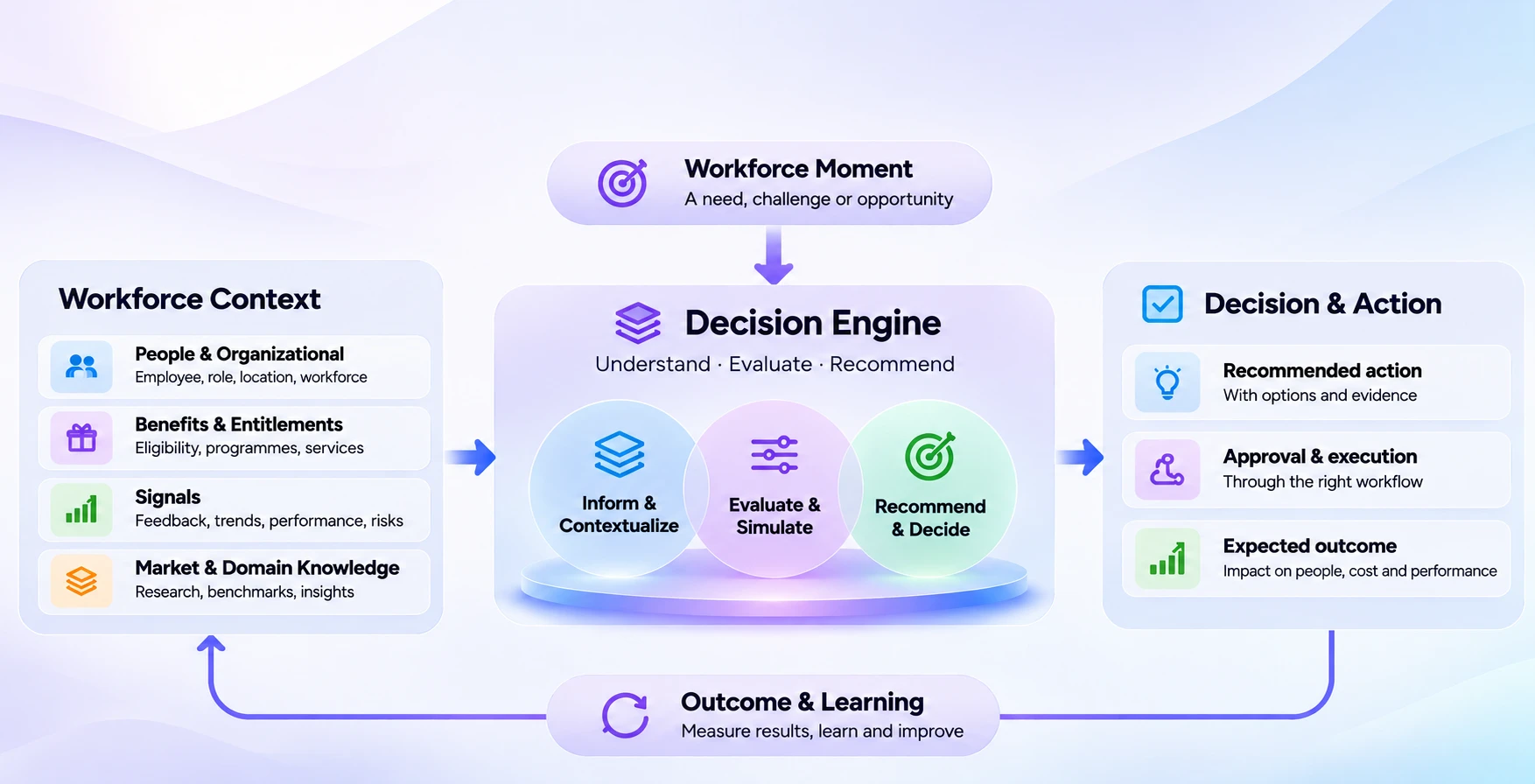
Seven kinds of information, organised around how a decision is made.

Understand
Context dataRole, location, organisation and circumstances
Entitlement and service dataBenefits, services, eligibility and access
Signal dataTrends, feedback, patterns and emerging risks
Knowledge and benchmark dataAdvisory research, market benchmarks and expertise
Decide
Decision and scenario dataEligibility, prioritisation, options, cost and impact modelling
Act
Action and workflow dataRequests, approvals, recommendations and execution
Learn
Outcome dataObserved results, workforce changes and feedback

A proposed architecture, not confirmation that every data source or integration exists.

Workforce decision engine: context feeds understand, evaluate and recommend, leading to decision, action and learning

BInvestment Simulator

Leaders compare levers before committing budget.

Scenario

Retaining critical AI talent in a key US technology hub, within the annual investment envelope.

Choose an investment lever
Estimated effect
Estimated cost
Estimated saving
Retention impact
Speed to value

Illustrative prototype values, not client data or measured results.

CAnatomy of a Recommendation

Every recommendation carries its reason, evidence, cost, outcome and approval path.

Recommendation

Fund a career pathway programme for AI engineers in the technology hub

Why it matters
Rising intent-to-leave signals in a critical skill group.
Evidence
Engagement feedback, market pay benchmarks and internal attrition trends.
Estimated cost
Fits within the regional investment envelope.
Expected outcome
Better retention of critical talent and stronger internal mobility.
Approval path
  1. Regional Manager proposes
  2. Total Rewards validates cost
  3. Country Head approves

DCapabilities by Level

Workforce signals

Engagement, wellbeing, retention, external sentiment, benefit use and spend in one view.

Contextual recommendations

Grounded in priorities, regional context, benchmarks and budgets, with evidence shown.

Investment planning and simulation

Compare requests, model scenarios, review cost, ROI and payback, prepare plans.

Decision and approval workflows

Cost validation, country review, finance and HR approvals, plan tracking.

Employee privacy matters: individual signals are never shown where only aggregated workforce views are appropriate.

EOne Ecosystem, Three Journeys

CountryJordan Hale, Country Head

Sets priorities, evaluates investments, approves direction

Better-informed investment decisions
Regional and teamMaya Chen, Regional Manager

Interprets signals, identifies needs, recommends interventions

Relevant interventions and development
IndividualLeo Martins, Employee

Discovers opportunities, takes action, experiences outcomes

Relevant support and personal growth

A conceptual relationship between the three levels, not a strictly sequential approval workflow.

UserJordan Hale, Country Head
Scenario

Retaining critical AI talent in a key US technology hub within the annual budget.

Goals
Clear view of conditionsEvidence-based investmentA plan that can be tracked
Phase 1Discover
  1. 1Understand country priorities
Today
With intelligence

“Ten reports, no clear picture”

“Priorities at a glance”

Intelligence does

Summarises workforce conditions and regional differences

How

Combines HR records, engagement and market signals

Ownership

Country Head

Phase 2Engage
  1. 2Connect cross-region signals
Today
With intelligence

“Every region says it is urgent”

“I can compare like for like”

Intelligence does

Lines up regional requests against trends and employee needs

How

Connects requests, signals and market intelligence

Ownership

Country Head

Phase 3Qualify
  1. 3Benchmark country-wide gaps
Today
With intelligence

“Are we really behind the market?”

“Gaps backed by evidence”

Intelligence does

Benchmarks against the market and ranks gaps

How

External compensation and benefits benchmarks

Ownership

Country Head, with Total Rewards

Phase 4Commit
  1. 4Simulate investment levers
Today
With intelligence

“What if I choose wrong?”

“I have seen the trade-offs”

Intelligence does

Simulates options with cost, savings, impact and payback

How

Scenario models on the investment envelope

Ownership

Country Head approves; Finance and HR validate

Phase 5Grow
  1. 5Launch and track the plan
Today
With intelligence

“Did it actually work?”

“Outcomes in view”

Intelligence does

Tracks the plan and workforce outcomes

How

Outcome data feeds the next cycle

Ownership

Country Head

TodayWith intelligence
“Priorities at a glance”
“I can compare like for like”
“Gaps backed by evidence”
“I have seen the trade-offs”
“Outcomes in view”
“Ten reports, no clear picture”
“Every region says it is urgent”
“Are we really behind the market?”
“What if I choose wrong?”
“Did it actually work?”
Opportunities, how and ownership

Emotions and thoughts are illustrative.

FExpected Value

Organisation
  • Clearer view of workforce conditions
  • More contextual investment decisions
  • Better prioritisation of regional needs
  • Investments linked to potential outcomes
  • Better use of benefits and resources
Managers
  • Faster access to team insight
  • Better understanding of team needs
  • More informed requests
  • Development linked to priorities
Employees
  • More relevant benefits and support
  • Easier access to growth
  • More meaningful recognition
  • Better discovery of services

Expected value of a proposed experience, not measured results from a deployed product.

The idea

One workforce intelligence ecosystem, three levels of decision-making and experience.

From fragmented workforce information to connected intelligence and action: helping country leaders invest with evidence, managers act on what their teams need, and employees find the support that fits their lives.

Expected value of a proposed experience, not measured results from a deployed product.

Next case study

Municipal Waste Collection

Civic services