



Managers buried in admin
Branch managers spend an average of 11.6 hours a week on scheduling and administrative tasks, up from 8 hours in 2018.
Source: Zebra, Sixth Annual International Branch Banking Employee Survey, 2025
Turning branch banking into an adaptive, intelligence-led execution experience

Bank branches are evolving from transaction counters into relationship-led, advisory and digitally enabled spaces. Bankers manage relationships, spot opportunities, resolve requests and handle operations across increasingly complex environments.
But bankers do not work the same way. A Branch Manager, a Teller and a Client Relationship Consultant have different priorities, information needs, decision authority and execution requirements. Branches also need to understand their local markets and keep customers connected across channels.
Different information, capabilities and decision authority.
Different needs for guidance, assistance and autonomy.
Different interaction patterns and workflows.
Customer needs extend beyond single branch visits.
Limited visibility of local segments and opportunities.
Journeys span branch, mobile, online and contact centre.
Systems offer predefined steps, not context-sensitive support.
How might wecreate an adaptive banking experience that equips bankers with the right intelligence, guidance and execution capabilities based on their role, experience and operating context?
Branch managers spend an average of 11.6 hours a week on scheduling and administrative tasks, up from 8 hours in 2018.
Source: Zebra, Sixth Annual International Branch Banking Employee Survey, 2025
41% of branch employees spend less than half their time on meaningful customer interactions.
Source: Zebra, Sixth Annual International Branch Banking Employee Survey, 2025
In many commercial banks, relationship managers spend just 25 to 30 percent of their time in client dialogue.
Source: McKinsey, Agentic AI is here. Is your bank's frontline team ready?
Nearly half of banking executives ranked data readiness as their top AI obstacle.
Source: McKinsey research, reported by Banking Dive
The branch is not one uniform environment. It spans different branch models, roles, customer segments and situations.
The opportunity: connect these through one experience, without assuming every banker needs the same information or workflow.

Bankers share an ecosystem but differ in responsibilities and needs.
Guidance should adapt to the banker's experience and task complexity.
The same task needs different decisions by intent, risk, mode and conditions.
Engagement needs relationships, needs and history across channels.
Priorities should reflect each branch's local market.
Recommendations matter only when they can be validated and acted on.
Systems, channels and workflows must work together.
We explored how branches operate, how bankers differ and where the experience breaks down.
Same experience for every role and level
Role-aware information, guidance and capabilities
Predefined even when situations change
Context-aware responses to intent, risk, mode and load
Information spread across systems and channels
Deep customer context in one place
Priorities miss local segments and opportunities
Local market intelligence for engagement and growth
Little continuity between branch and digital
Omnichannel view of past and ongoing activity
Limited view of products and partner offers
An integrated marketplace that matches needs
Consultations depend on branch visits
Remote consultations, requests and follow-ups
Checks, recommendations and execution disconnected
Orchestration from insight to validated action
The AI-in-the-Loop Banker Execution Architecture: BEE is an adaptive, intelligence-led banking experience. It adapts how intelligence, guidance and actions are delivered to each banker's role, experience, mode and context, and connects local market insight, customer context, channels and solutions.
Understand the market. Align priorities. Identify opportunities.
Local segments, business characteristics and engagement opportunities.
Connect interactions. Preserve context. Enable continuity.
Interactions, history and open requests across branch, mobile, online and contact centre.
Understand behaviour. Identify needs. Inform decisions.
Profiles combined with behaviour, finances, relationships and intent.
Discover solutions. Match needs. Connect offerings.
Bank products, services and partner offerings matched to needs.
Extend reach. Enable remote service. Maintain relationships.
Remote consultations, service requests and follow-ups.
Four functional agents, coordinated by an Orchestration Agent.
Coordinates the agents, activates the right capabilities, manages handoffs and adapts the flow as situations change.
Watches interactions and operations, detects meaningful events and triggers workflows.
Gathers customer, market and interaction context and understands intent, patterns and risk.
Checks rules, eligibility, risk and constraints, and recommends with justification.
Carries out approved actions, updates systems and records outcomes and compliance.
The Orchestration Agent works across the architecture rather than as another step in sequence.
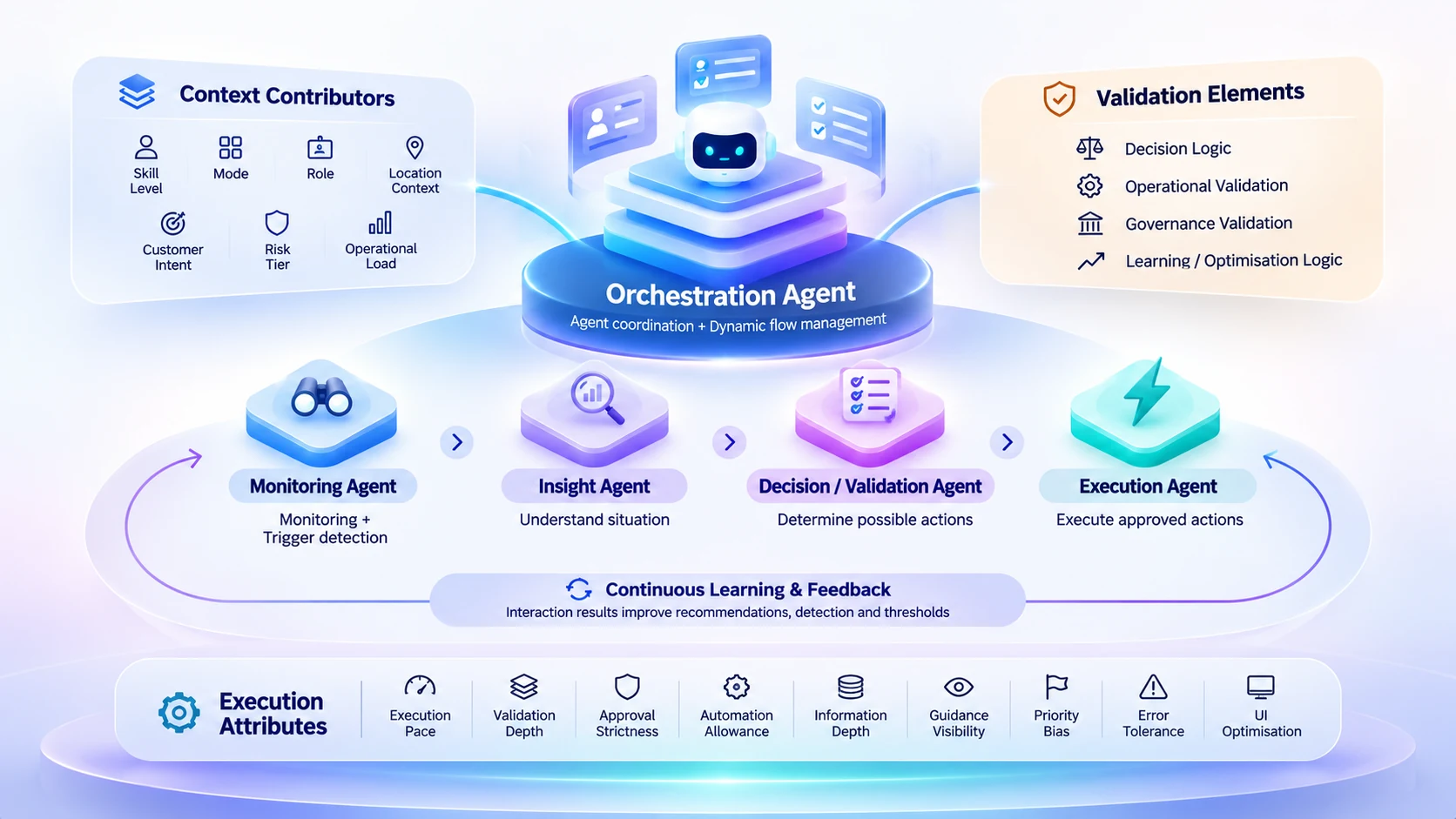
What BEE reads, how it checks and how it behaves.
Skill level
Mode
Role
Location context
Customer intent
Risk tier
Operational load
These contributors decide what information is shown, which recommendations fit and how much guidance is needed.
BEE does not remove the banker from decisions. The level of human involvement depends on the action, risk, authority and governance.
One branch, one day. BEE adapts to each banker and each moment, from the morning plan to tomorrow's priorities.
Starting the day when a consultant is suddenly unavailable.
“Juggling three systems”
“Clear view of my day”
Builds an adaptive plan and flags high-value appointments
HowInsight Agent reads appointments, staffing and priorities
OwnershipManager confirms
“Who covers these customers?”
“Options ready in seconds”
Detects affected appointments and recommends replacements by skill and availability
HowMonitoring Agent detects; Decision Agent matches skills and availability
OwnershipManager approves
“Calling everyone by hand”
“Sorted in minutes”
Drafts customer notices and updates the plan
HowExecution Agent sends notices and updates the plan
OwnershipManager oversees
A walk-in customer with a card question who later asks to close an account.
“Who is this customer?”
“I know who I am talking to”
Brings together profile, behaviour, needs and recent interactions
HowInsight Agent connects profile, behaviour and history
OwnershipConsultant
“Am I allowed to waive this?”
“Clear, fair options”
Checks eligibility and waiver rules and recommends resolutions
HowDecision and Validation Agent checks eligibility and waiver rules
OwnershipCustomer chooses; consultant validates
“I can't stop them leaving”
“We kept them”
Detects closure intent and suggests retention options
HowMonitoring Agent detects intent; Execution Agent records the outcome
OwnershipConsultant validates
Serving customers across the contact centre, video and mobile in one afternoon.
“Please explain it again”
“Full history in front of me”
Shows history and open requests from every channel
HowInsight Agent pulls history from every channel
OwnershipConsultant
“Remote feels second best”
“Same help, any channel”
Prepares discussion points and pre-fills requests
HowInsight Agent prepares; Execution Agent pre-fills after validation
OwnershipExecuted after validation
“Follow-ups get forgotten”
“Nothing slips”
Schedules follow-ups on each customer's preferred channel
HowOrchestration Agent schedules across channels
OwnershipConsultant confirms
Closing the day by turning local insight into tomorrow's opportunities.
“I don't know my local market”
“New businesses nearby”
Highlights local segments and opportunities
HowInsight Agent reads local market and segment data
OwnershipBranch Manager
“Which product fits?”
“Right offer, right customer”
Matches needs with bank and partner offerings and suggests who to approach
HowDecision Agent matches needs to bank and partner offerings
OwnershipConsultant decides
“Tomorrow starts from zero”
“Tomorrow is already planned”
Feeds the day's outcomes into tomorrow's plan
HowLearning logic feeds outcomes into the next plan
OwnershipBranch Manager
Emotions and thoughts are illustrative.
These are intended outcomes of the proposed experience, not measured results.
The right intelligence, the right guidance and the right action, for every banker, every customer and every situation.
Rather than giving every banker the same interface and predefined workflow, BEE brings together intelligence, guidance and execution that respond to who the banker is, how they work, what the customer needs and what the situation demands.
It also extends the branch beyond its walls, connecting local market intelligence, customer relationships, channels and relevant solutions.
These are intended outcomes of the proposed experience, not measured results.